Chatbot with Touch and Graphics: An Interaction of Users for Emotional Expression and Turn-taking
At a glance
- What
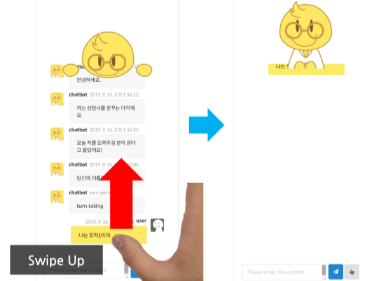
- TwG adds touch gestures and an on-screen character to a text chatbot so a user can send an emotion or hand over the turn.
- Why
- Text-only chat carries no nonverbal cues, so a chatbot struggles to read the user's emotion or tell where a turn ends when one topic spans several short messages.
- How
- It maps six emotions to touch gestures the character answers with an expression; swiping the chat bubble up hands over the turn. In a Wizard of Oz study 28 participants compared it with text-only chat.
- New
- Touch and graphics stand in for nonverbal cues text chat lacks: emotional connection rose from 3.51 with text only to 4.39 with TwG, and turn-taking felt more natural.
Abstract
Use of chatbots for emotional exchange is recently increasing in various domains. However, as existing chatbots have been considered in terms of natural language processing techniques for interaction with text-based chatting, chatbot interaction with users is lacking in terms of considering the emotions of users and managing turn-taking in conversation. This paper suggests an interaction technique having touch interactions with graphic interfaces (TwG) to solve these problems. In the system, users send their emotions and manage turn-taking through TwG technique. We conducted a Wizard of Oz study to evaluate user experience on emotional expression and turn-taking with TwG technique. Results showed that TwG interaction improved emotional expression compared to a traditional text-based chatbot interaction. Furthermore, the results showed that TwG positively affects natural turn-taking of the conversation.